
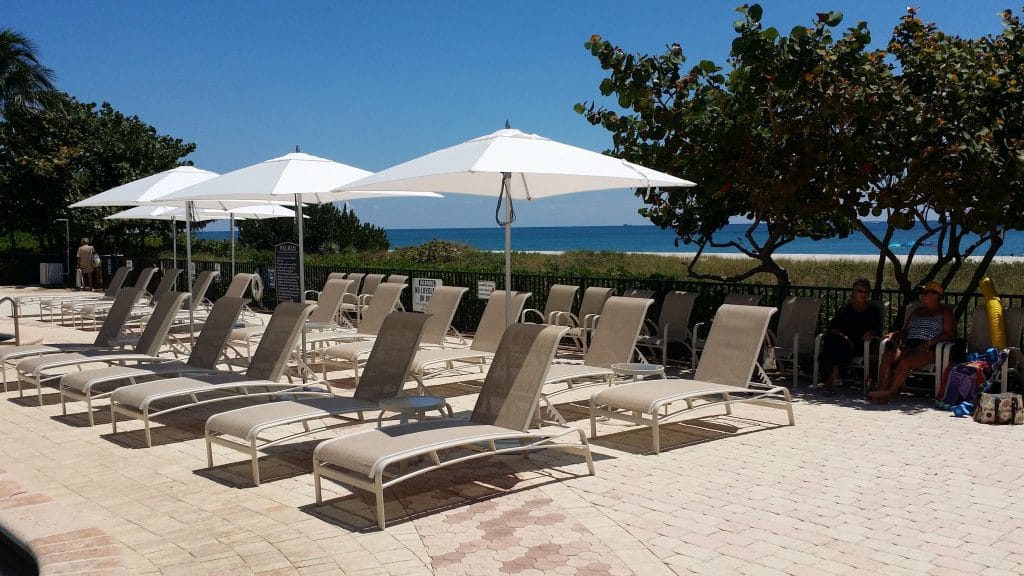
If you manage a community pool area, you’ve probably faced this exact decision: repair or replace outdoor pool furniture.
The good news: most “worn-out” pool furniture isn’t truly finished. In many HOA and commercial settings, the frames are still structurally sound—it’s the slings, straps, hardware, or finish that make everything look tired, mismatched, and non-compliant with community standards.
This guide walks HOA board members and community managers through a clear decision process—built around budget cycles, compliance expectations, resident experience, and long-term planning—so you can choose the most cost-effective option without sacrificing the look of your amenities.
Quick answer: should you repair or replace outdoor pool furniture?
In many communities, the best option is to repair or restore when:
- Frames are stable and safe
- Only the fabric, straps, or finish are worn
- You want a fast refresh without major downtime
- You’re trying to stay within annual budget limits (or avoid a surprise assessment)
Replacement tends to be the better call when:
- Frames are cracked, bent, or unsafe
- Welds repeatedly fail
- Corrosion has weakened structural integrity
- You need a full layout/spec upgrade for higher traffic or a new design standard
Why this decision matters for HOAs
HOA pool furniture isn’t just a “nice-to-have.” It impacts:
- Resident satisfaction (complaints rise fast when pool areas look neglected)
- Safety and liability (wobble, sharp edges, failing seats)
- Budget cycles (operating funds vs reserves)
- Compliance and standards (commercial expectations and performance criteria)
Reserve planning standards recognize that the schedule for repair or replacement can be based on end of useful life—not only visible deterioration.
And when funds are tight, many communities consider deferring replacement for non-critical aesthetic items—pool furniture often falls in that category.
The HOA decision checklist: repair vs replace (in 10 minutes)
Walk your pool deck and check these four areas:
1) Safety & structure (most important)
Choose replacement if you see:
- Cracks in frame joints
- Unstable wobble even after tightening bolts
- Sharp edges or exposed broken parts
- Repeated weld failures
Choose repair/restoration if:
- Frames are solid
- Hardware is replaceable
- Issues are mostly fabric/finish related
2) Appearance & uniformity (resident + board pressure)
The biggest HOA complaint isn’t “the chair broke.” It’s:
- “Everything looks mismatched”
- “The pool area looks old”
- “Some chairs look newer than others”
Restoration is often the fastest way to return the pool deck to a consistent, upgraded look—without replacing entire sets.
3) Timeline & downtime
Replacement can involve:
- Longer lead times
- Freight scheduling
- Disposals
- Assembly / staging
Repair projects can often be scheduled in phases (more on that below).
4) Budget & reserve strategy
Reserve study guidance focuses on identifying components the association is obligated to repair/replace/restore and establishing remaining useful life and cost planning.
Translation: your board decision should connect to a funding plan, not just a vendor quote.
What “repair” really includes for outdoor pool furniture
When HOAs say “repair,” they usually mean restoration—returning furniture to a like-new appearance and performance.
Re-slinging (best for sling chairs & chaise lounges)
If your chairs feel saggy, torn, stretched, or stained—but the frame is fine—re-slinging replaces the fabric while keeping the original frame. This is one of the most common HOA solutions because it delivers a dramatic visual refresh without replacing furniture lines.
Re-strapping (for vinyl strap chairs)
If straps are brittle, snapped, or stretched, re-strapping gives chairs a clean, uniform look again—often with updated strap colors to match community aesthetics.
Refinishing / powder coating frames (for faded, peeling, chalky frames)
South Florida sun and humidity can cause:
- Fading
- Chalky oxidation
- Peeling paint
- Corrosion spotting
Refinishing or powder coating is often positioned as a cost-effective alternative to replacement that extends the life of metal furniture.
Hardware refresh (the “small fix” that prevents big problems)
Many “wobbly chair” complaints come from:
- Loose fasteners
- Missing glides
- Worn caps
- Corroded screws
Replacing hardware and stabilizing frames can reduce safety issues fast—especially before peak season.
Umbrella repair or canopy replacement (pool deck essentials)
If your umbrellas are leaning, jammed, or faded, you may be able to repair mechanisms or replace canopies instead of buying new full systems.
When replacement makes more sense (and saves headaches)
Even if restoration is cheaper, replacement is the smart decision when:
The frames are not structurally reliable
- Repeated repairs don’t hold
- Cracks return
- Corrosion has weakened structural points
Your HOA needs a new spec or design standard
Examples:
- Switching to stackable commercial chaises
- Matching a renovated pool deck
- Upgrading to heavier-duty furniture for higher resident volume
You can’t match parts or lines
If a furniture line is discontinued and parts can’t be sourced, replacement may prevent ongoing mismatches.
Compliance and performance: what HOAs should know (without getting too technical)
For commercial and public environments, outdoor seating is commonly evaluated based on stability, structural strength, durability, and tip-over resistance. ASTM standards exist that cover aspects of table and chair safety and performance.
You don’t need to memorize standards—but you do want a process that supports:
- Safe seating that doesn’t rock or tip easily
- Durable finishes suitable for pool chemicals and sun exposure
- Consistent appearance aligned with community rules and expectations
The budget-cycle approach: how HOAs plan this without surprises
A practical model many boards follow:
Option A: Restore now, replace later (reserve-friendly)
- Use operating budget to restore appearance and safety this year
- Align replacement with a future reserve cycle (or phased capital plan)
Reserve guidance emphasizes planning for repair/replacement/restore items and building funding strategies around useful life and remaining useful life.
Option B: Phase the project across two budget periods
- Phase 1: restore the most visible zones (pool deck perimeter, main lounge area)
- Phase 2: complete remaining inventory next quarter or next fiscal cycle
Option C: Replace only what must be replaced
- Replace unsafe frames
- Restore everything else for visual consistency
This “hybrid approach” is often ideal for large communities with mixed furniture conditions.
A simple decision framework (use this at your next board meeting)
Choose repair or replace outdoor pool furniture based on the frame:
If the frame is solid → restore
- Re-sling / re-strap
- Refinish / powder coat
- Replace hardware
If the frame is compromised → replace
- Cracks
- Severe instability
- Structural corrosion
- Repeated weld failures
Rule of thumb: If you can’t confidently say “this is safe for residents” after restoration, replace it.
How to get accurate quotes for HOA pool furniture (and avoid back-and-forth)
To speed up the estimating process, gather:
- Photos (wide pool deck + close-ups of damage)
- Counts by type (chaises, dining chairs, loungers, bar chairs, tables)
- Notes: sling vs strap, any broken frames, any missing pieces
- Goal: “uniform look,” “match existing,” or “upgrade colors”
Pro tip: If you have 100+ pieces, organize photos by group: “Chaise Lounges,” “Dining Chairs,” “Bar Area,” etc.
Planning to keep the pool open: phased restoration scheduling
Many HOAs assume repairs require shutting down the pool deck. In reality, larger projects can often be scheduled in phases:
- Zone A / Zone B scheduling
- Pick-up and return windows
- Priority restoration for the most-used sections first
This approach minimizes resident disruption while keeping your amenity presentable.
If you’re in South Florida: a proven repair option for HOAs
Beach & Patio Outdoor Living (Pompano Beach, FL) specializes in outdoor furniture services often used by commercial and HOA clients—re-slinging, re-strapping, refinishing, umbrella repair, and custom solutions.
They’ve served South Florida since 1979 and support both residential and commercial needs.
For quotes, you can send project info through their contact channel (including email and showroom location).
Final takeaway
If you’re deciding whether to repair or replace outdoor pool furniture, don’t start with “How old is it?”
Start with:
- Is the frame safe and stable?
- Do we need a uniform look fast?
- What does our budget cycle support?
- Can we phase the work to reduce downtime?
In many HOA communities, restoration delivers the best combination of:
- Cost control
- Compliance confidence
- Fast visual upgrades
- Better resident experience
Repair or Replace Outdoor Pool Furniture: FAQ
Should an HOA repair or replace outdoor pool furniture?
When is repairing outdoor pool furniture the smarter option?
When should we replace outdoor pool furniture instead of repairing it?
What repairs make the biggest difference for pool areas?
Can we repair outdoor pool furniture without closing the pool?
How does “repair vs replace” affect HOA budget cycles?
What information do we need to get an accurate repair quote?
How can we keep the pool deck looking uniform if we replace only some pieces?
If you’re deciding whether to repair or replace outdoor pool furniture, start with a simple rule: if the frames are structurally sound, restoration (re-slinging, re-strapping, refinishing) can often deliver a uniform, “like-new” pool deck look without the cost and downtime of full replacement. For more guidance on planning projects around HOA budgets and reserve funding, explore the Community Associations Institute (CAI).
Not sure whether to repair or replace outdoor pool furniture for your community? If the frames are still solid, re-slinging, re-strapping, and refinishing can restore a clean, uniform pool deck look while protecting your budget. Learn more about our repair options on our Beach & Patio Outdoor Living website. CTA: Send photos of your pool furniture (include your name, city, and phone number) to [email protected] and we’ll reply with a quote within 24 hours.